





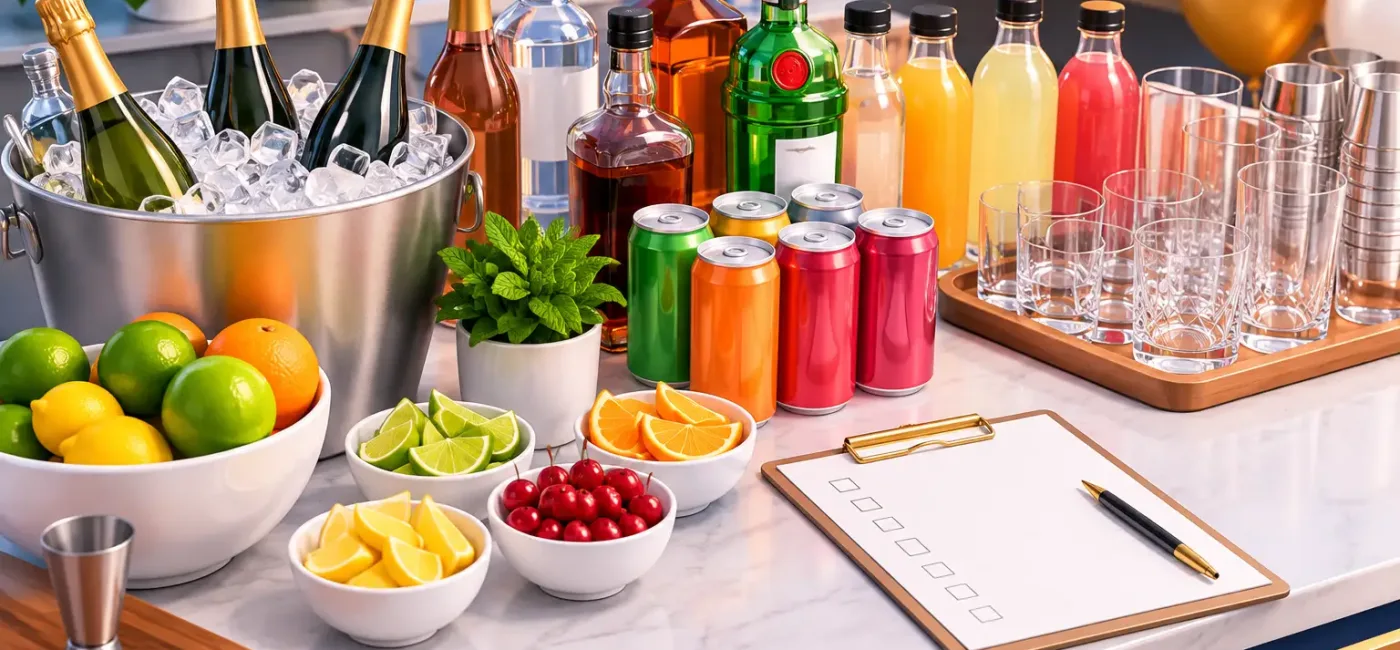
A good party bar checklist prevents the two hosting problems nobody wants: a full bottle of something no one touches and an empty ice bucket before the first guests arrive. The goal is not to build a hotel bar in your kitchen. It is to stock the drinks your crowd will actually order, buy the right quantities, and keep service easy from the first toast to the final ride home.
Start with the guest list, the party length, and the kind of occasion. A relaxed afternoon barbecue needs a different mix than a birthday dinner, office celebration, or late-night house party. Once those three details are clear, the rest of the shopping list gets much simpler.
Start Your Party Bar Checklist With Headcount
Plan for the guests who are likely to drink, not just the total number invited. For a typical four-hour party, estimate two drinks per guest in the first hour and one drink per guest for every hour after that. A group of 20 drinkers at a four-hour event may therefore have around 100 drinks across beer, wine, cocktails, and nonalcoholic options.
That number is a planning tool, not a rule. Increase it for a Friday or Saturday evening, a celebration built around drinking, or a crowd that prefers beer and cocktails. Reduce it for a lunch gathering, a family event, or a party where food is the main attraction. If guests are bringing bottles, count those only when they have confirmed what they are bringing.
Do not make every category equally large. Ask yourself what your guests usually reach for. A wine-focused dinner can lean heavily toward red, white, and sparkling wine. A game-night crowd may go through beer, cider, and easy mixed drinks faster. For a mixed group, a practical split is roughly 40 percent beer and cider, 30 percent wine and sparkling wine, 20 percent spirits and mixers, and 10 percent nonalcoholic drinks. Adjust the ratio rather than buying every possible drink style.
Choose a Simple, High-Use Drink Lineup
A bar with too many bottle choices is expensive and slow to serve. Keep the range broad enough for different preferences, then choose formats that work across several drinks.
For most parties, build around four alcohol lanes:
- Beer and cider for easy, no-mixing pours
- Red, white, and sparkling wine for meals and toasts
- Two or three versatile spirits for highball cocktails
- One premium or celebratory bottle for sipping, gifting, or a toast
Vodka, gin, tequila, whisky, and rum can all earn a place, but you do not need all five. Choose based on the drinks you will actually serve. Vodka works for vodka sodas, mules, and juice-based mixers. Gin covers gin and tonics. Tequila makes sense when margaritas or palomas are on the menu. Whisky is a strong choice for a crowd that likes highballs, old fashioneds, or neat pours.
If you are serving cocktails, limit the menu to two signature options plus a simple highball. For example, tequila with grapefruit soda, gin with tonic, and a batch of margaritas cover a lot of ground without requiring ten specialty ingredients. A full cocktail menu sounds impressive, but it often leaves the host measuring, shaking, and cleaning while everyone else is having fun.
Bottle and Can Quantities That Make Sense
A standard 750 ml wine bottle provides about five glasses. A 750 ml spirits bottle makes roughly 16 standard 1.5-ounce pours, although generous home pours can reduce that quickly. A 12-pack of beer or cider covers 12 servings, while a 24-pack gives useful breathing room for larger groups.
For 20 guests over four hours, a balanced starting order might include two 24-packs of beer or cider, 10 to 12 bottles of wine across red and white, three to four bottles of sparkling wine, and three 750 ml spirit bottles with enough mixers for 40 to 50 highballs. This is a starting point, not a fixed formula. A wine-heavy dinner may need 16 bottles of wine and far less beer. A casual outdoor party may need more cans, less glass, and no sparkling wine beyond one or two bottles for a toast.
Buy a little extra of the crowd favorite, especially when it is shelf-stable. Unopened spirits, canned beer, and many wines can stay ready for the next gathering. Running out of ice or light beer is much more frustrating than having a few unopened cans left over.
Do Not Underbuy Mixers, Ice, and Water
Spirits are only half of a mixed drink. Every bottle of liquor needs a realistic amount of mixer, garnish, and ice behind it. For every 750 ml bottle used mainly for highballs, have enough tonic water, soda water, cola, ginger beer, juice, or grapefruit soda to make at least 15 drinks.
Stock more soda water than you think you need. It works with vodka, gin, tequila, whisky, and wine spritzes, and it gives guests a lighter option between stronger drinks. Keep regular and diet cola separate if both are expected. For garnishes, limes do the most work, followed by lemons. Skip complicated garnish trays unless the drink menu truly calls for them.
Ice is the most commonly missed party supply. Plan on one to two pounds per guest for a party serving cocktails, chilled cans, and wine. Use the higher end for warm weather, outdoor gatherings, or drink-heavy events. You need ice for coolers and tubs as well as glasses, so do not count one bag twice.
Water belongs at every bar station. Put still water, sparkling water, and cups or glasses where guests can see them. Nonalcoholic beer, alcohol-free sparkling wine, and a good zero-proof mixed drink help guests participate without having to settle for plain soda. These choices are not an afterthought. They make the party more welcoming and help everyone pace themselves.
Set Up the Bar for Fast Self-Service
Keep the bar away from the food table if space allows. It reduces crowding and gives guests room to pour without blocking people who are eating. Put bottles in one area, chilled beer and cider in tubs or coolers, and glassware or cups at the start of the station.
Place the most popular items at eye level: beer, wine opener, cups, ice bucket, water, and the mixers for your main cocktails. Keep premium bottles slightly separate so they do not accidentally become the default pour for every mixed drink. If you are opening Champagne or sparkling wine, chill it well in advance and open bottles as needed rather than putting every bottle out at once.
Glassware does not need to match. Wine glasses, highball glasses, and sturdy cups are enough for most home parties. If you use disposable cups, choose a heavier option that will not collapse around ice. Have a marker nearby so guests can label their cups. It cuts down on waste and makes cleanup easier.
Food, Timing, and Responsible Hosting
Alcohol should not be the only thing available. Put out filling food early, not just late-night snacks after guests have already had several drinks. Salty snacks are useful, but add substantial options such as sandwiches, skewers, pizza, sliders, or a hearty dip with bread. Guests who have eaten are more comfortable, and the party stays on a better track.
Chill beer, cider, white wine, sparkling wine, mixers, and water before guests arrive. Red wine can sit at a cool room temperature, but a warm kitchen can make it taste flat and alcoholic. If refrigerator space is limited, prioritize the bottles and cans that must be served cold, then use coolers with ice for backups.
Have a transportation plan before the party starts. Encourage designated drivers, rideshares, and overnight arrangements where appropriate. Stop serving anyone who appears intoxicated, and never pressure guests to drink. The best hosts make it easy for people to say yes to another drink or no to one.
A well-stocked bar feels generous because it is intentional, not because it has the most expensive bottle on the counter. Buy for your guests, chill more water than you expect to need, and keep one backup case or bottle of the evening’s favorite drink. That small buffer lets you enjoy your own party instead of making an emergency store run.